Brink Commerce - Lowest price 30 days back
Written By Andreas Kimmehed
Last updated 10 months ago
Price
Price in this context is the sale price set through the Brink Commerce API or campaign price set through a rule with the Brink Commerce campaign manager. Every price is connected to a store group, country code (store market), and a product variant.
Active price
A price can only be counted as a lowest price if it has been able to be sold through the shopper API. That means that we have an active product variant and a sale price set. If a product variant is turned inactive we no longer record the price for the inactive period. Every time a price changes on an active product variant we start a new recording for that price.
Overlapping campaigns
Campaigns affect the prices of multiple products at the same time and can overlap dates of activity. The campaign giving the lowest price for that period is the price the product is sold for and the price that will be recorded.
30 days logic
An important notion here is that the law states that it is the 30 days before the discount starts. If there is a continuous lowering of the price, the reference price is the lowest price recorded 30 days before the start of the discount chain. When there is a price increase, the reference price will be moved to the lowest price 30 days back since the current date. At that point the item is usually no longer on sale and doesn't need a reference price. If the price then rests for 30 days or more before going on sale again, the higher price will be the reference price.
Examples
Example 1.
The bar chart illustrates an example of how the lowest price in the last 30 days is calculated when a discount is applied.
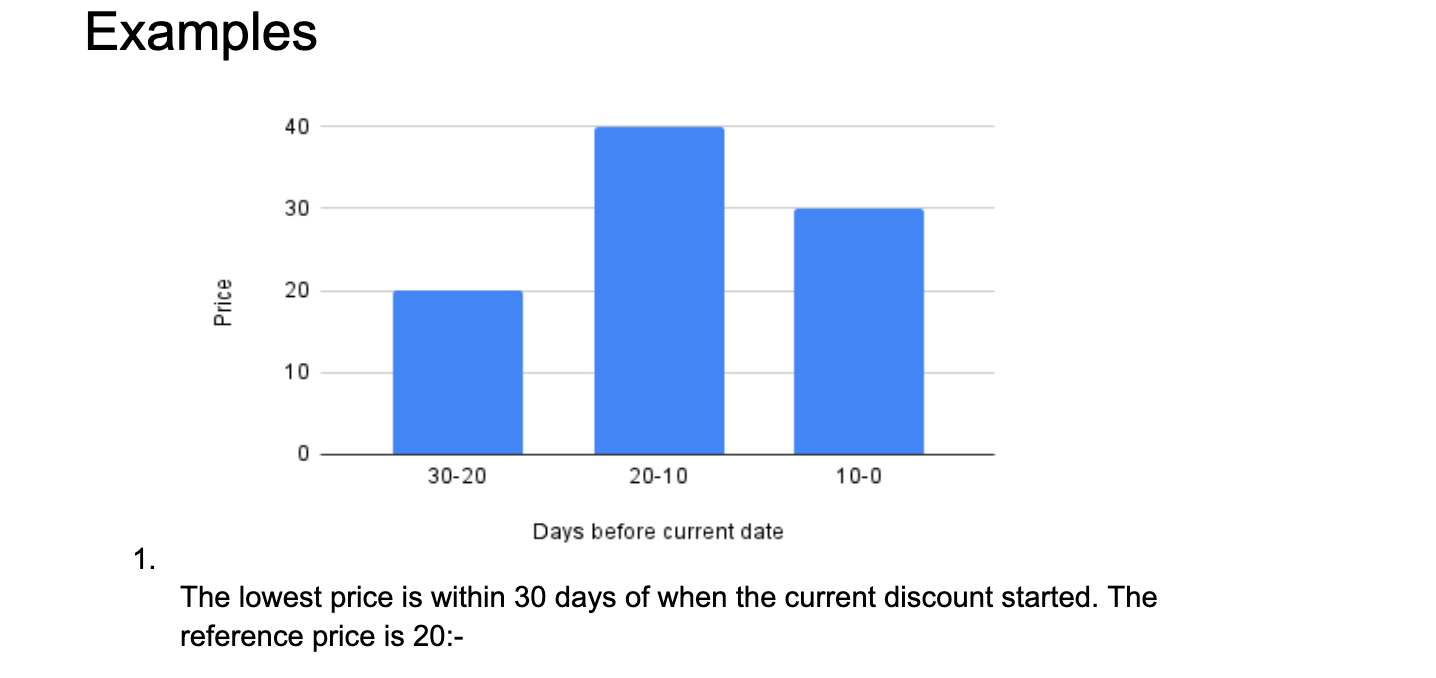
The bar chart shows the price history divided into three time intervals counting backwards from the current date:
30–20 days ago: price 20
20–10 days ago: price 40
10–0 days ago: price 30
When the current discount starts, you look 30 days back in time to identify the lowest price during that period. In this example, the lowest price is 20, which occurred during the period 30–20 days before the current date.
The reference price that should be displayed during the discount is therefore 20, as it is the lowest price within the 30-day period prior to the discount.
Example 2.
The bar chart illustrates a scenario where the price is continuously reduced over time.
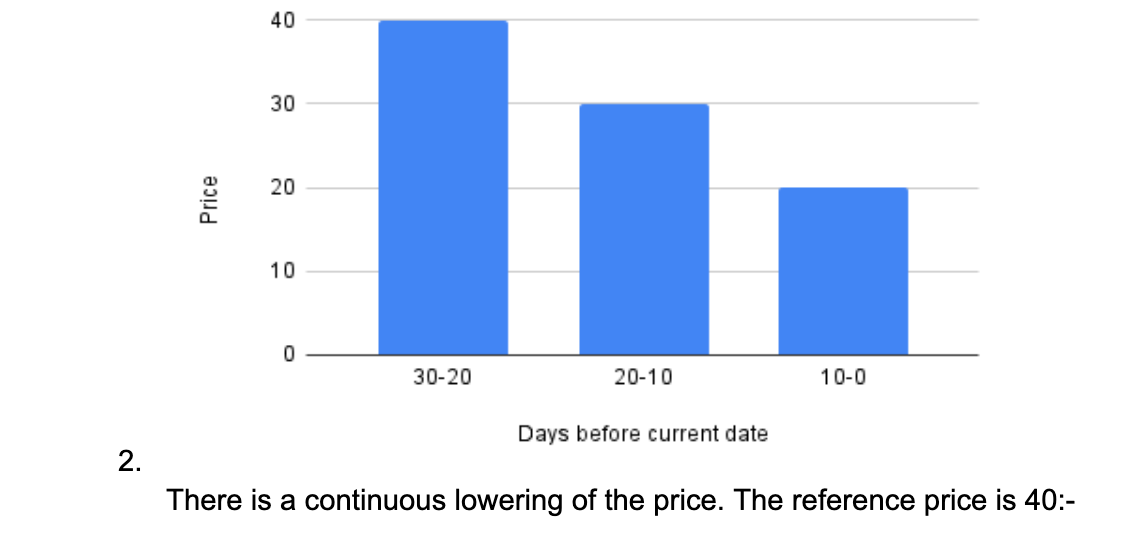
The bar chart shows the price history divided into three time intervals counting backwards from the current date:
30–20 days ago: price 40
20–10 days ago: price 30
10–0 days ago: price 20
In this case, the price has been gradually lowered, without any increase in between. According to the pricing rules, when a discount is applied after a continuous price reduction, the reference price is the price before the first reduction in the sequence.
That price is 40.
Therefore, the reference price that should be displayed is 40, even though the lowest price within the last 30 days is 20.
Example 3.
The bar chart illustrates a case where the price did not remain stable long enough before being reduced again.
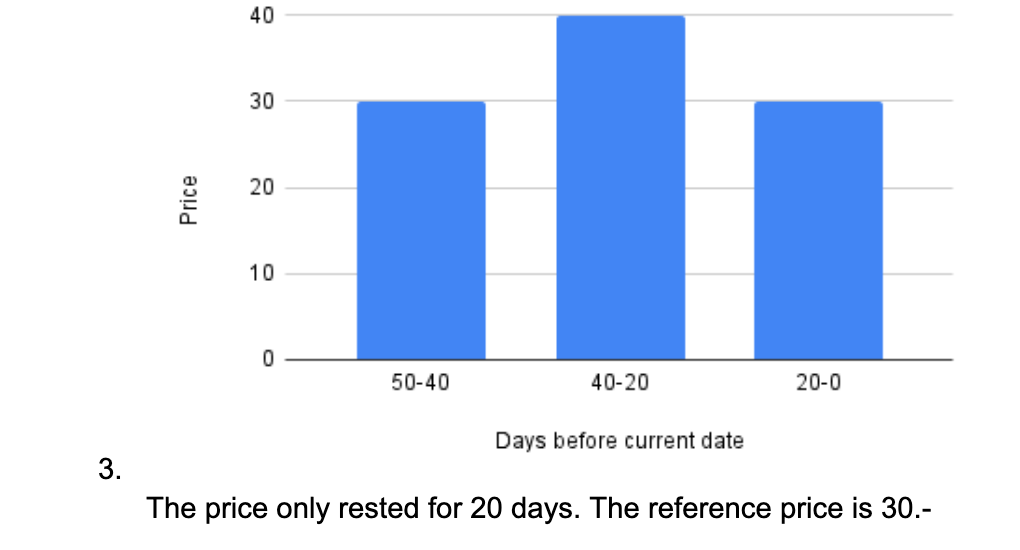
The bar chart shows the price history divided into three time intervals counting backwards from the current date:
50–40 days ago: price 30
40–20 days ago: price 40
20–0 days ago: price 30
In this scenario, the price increased to 40 but only remained at that level for 20 days before being reduced again. According to the pricing rules, for a price to be considered a new reference price, it must have been applied for at least 30 consecutive days. Since the price of 40 only lasted for 20 days, it does not qualify as a valid reference price.
Therefore, the reference price that should be displayed is 30, which is the last price that was stable for a sufficient period.
Examples 4.
The bar chart illustrates a case where the price rested for 30 days.
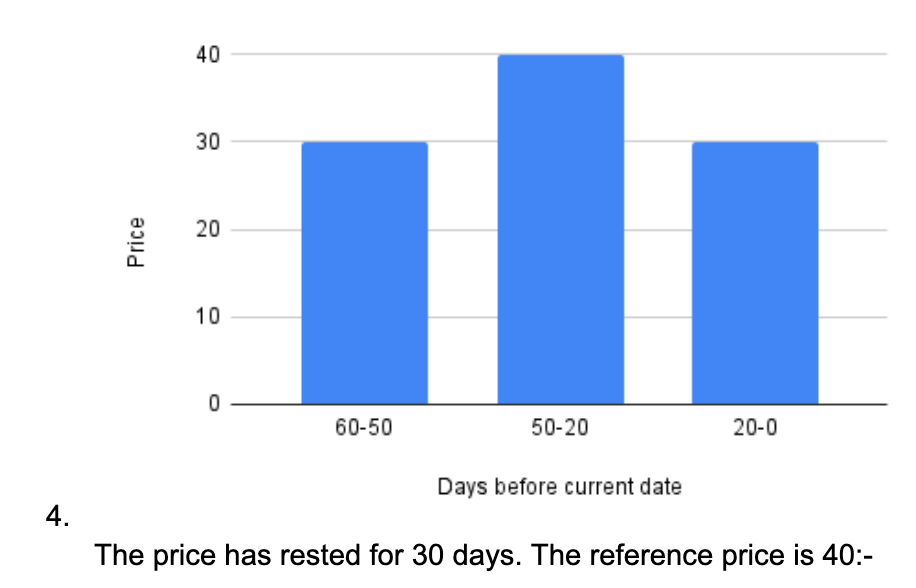
The bar chart shows the price history divided into three time intervals counting backwards from the current date:
60–50 days ago: price 30
50–20 days ago: price 40
20–0 days ago: price 30
In this scenario, the price increased to 40 and remained at that level for 30 days before being reduced again. According to the pricing rules, for a price to be considered a new reference price, it must have been applied for at least 30 consecutive days. Since the price of 40 lasted for 30 days, it does qualify as a valid reference price.
Therefore, the reference price that should be displayed is 40.
Was this helpful?
Still need help? Ask the team